PRESS RELEASE
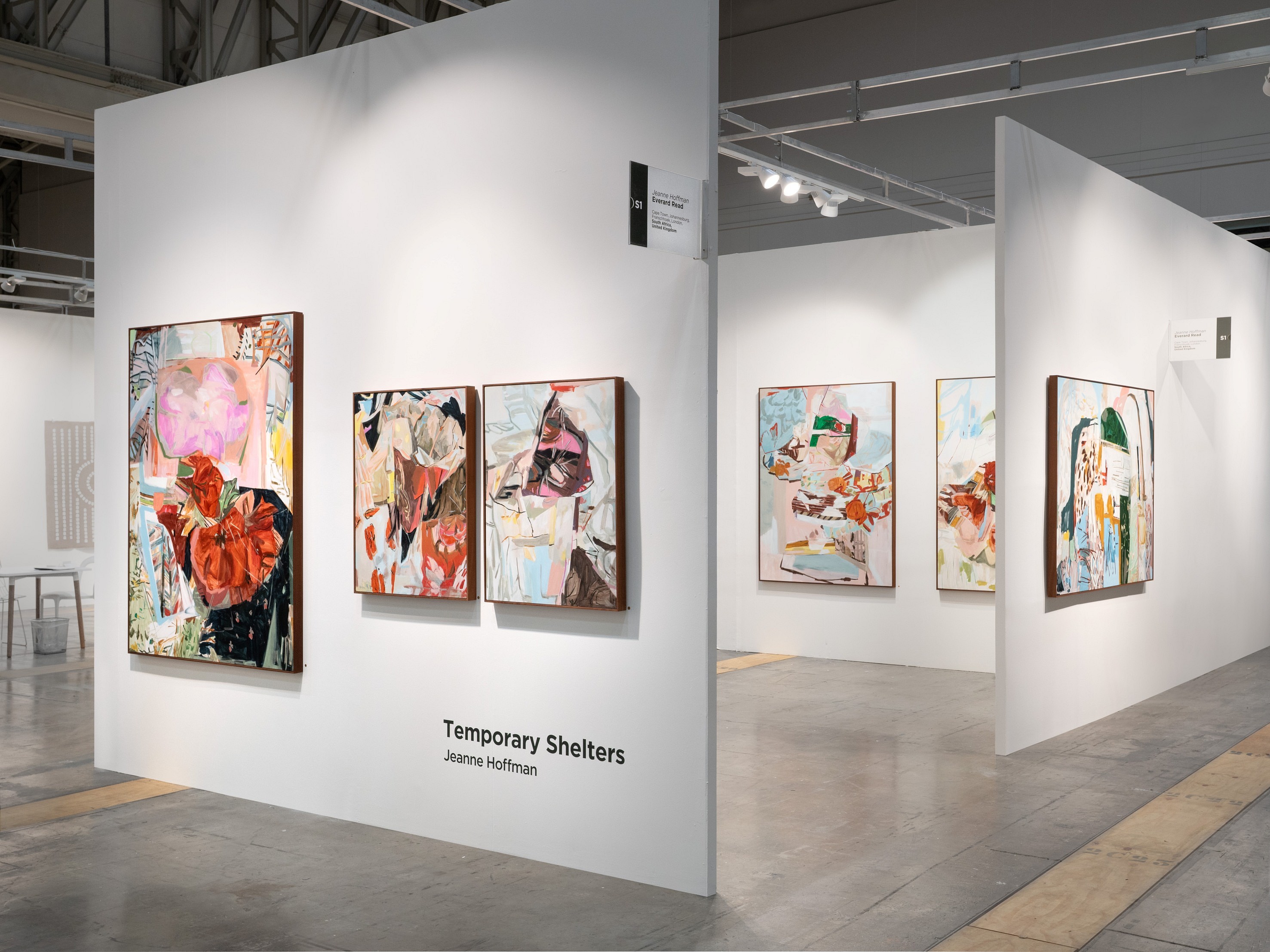
JEANNE HOFFMAN | TEMPORARY SHELTERS AT THE INVESTEC CAPE TOWN ART FAIR
Feb 17 – Feb 23, 2026
JEANNE HOFFMAN
Temporary Shelters
A Diagram of Precarious Moves
By Sean O’Toole
Jeanne Hoffman frequently reaches for metaphor when talking about what she does. “I have a sense always that painting is kind of gardening with fragments,” she says. Gardening here refers to a habit, one that involves sustained attention to multiple, discrete parts while holding an overall design in mind. Gardening is not simply ideational; it is physical and intuitive, demanding constant movement, adjustment and return. This approximates Hoffman’s studio practice. She works on multiple paintings simultaneously, establishing a rhythm across the studio as she alternates between action and response, problem and solution.
This alternation between intention and improvisation, between design and its breakdown at the surface of the canvas, is central to her practice. It informs the new paintings in Temporary Shelters, Hoffman’s solo presentation at the 2026 Investec Cape Town Art Fair. These works emerge from a long-evolved procedure, one that begins away from the canvas. Over the last two decades Hoffman has created an informal library of collages: intuitive assemblages of found photographs organised into abstract, often tonally harmonious configurations. Composed from whatever “attracts my eye in that moment”, these collages function as her preparatory drawings, but they should not be confused for blueprints. If anything, the collages are catalysts.
“The collage is the starting point and then I break from it,” she explains. The break is decisive. If collage gathers fragments of the world, painting tests their relations. In the studio, Hoffman’s paintings evolve collectively, through iteration. Surprise is inevitable. “Things can always go many ways and you can’t tell in advance,” she says. “So I spend a lot of time revisiting the same reference.” And yet, each painting unfolds as a sequence of careful decisions. Invoking critic Harold Rosenberg’s notion of the canvas as an “arena in which to act”, one might ask whether a Hoffman painting is an event site or a space of calculated construction.
“It is both,” she insists. The work records an encounter, but nothing is accidental. “I don’t put anything there without putting it intentionally.” Even so, the first mark is not triumphant. It initiates a process of revision in which forms are adjusted, overpainted, sometimes erased entirely. Looking back at a completed work from her previous exhibition, she found herself asking “Did I do that?” The question is less about doubt than recognition that painting exceeds intention.
Hoffman works in acrylic. “I am too impatient for oil,” she says. “It doesn’t dry fast enough.” The medium suits a temperament that prefers responsiveness over delay. Her core palette – titanium white, raw umber, burnt green earth, terracotta and Chinese orange – anchors the compositions. In the manner of Pierre Bonnard and Édouard Vuillard, both sensual colourists, Hoffman is unafraid to celebrate pattern and ornament. Her frequent use of tendril-like lines and clustered zones of colour reiterate the artifice of paintings, its status as “a flat surface covered with colours assembled in a certain order”, to quote Maurice Denis. “There is always a sense of balancing a mirror on the edge of a staircase,” she says. A painting, by this account, is equilibrium held at risk.
Colour operates according to its own discipline. Hoffman disavows allegiance to theory. “Maybe one day I’ll have to do some sort of intense Freudian analysis,” she wryly observes, wary of over-systematisation. What is consistent is her attitude to colour mixing. “I deliberately don’t mix. I always try to match what I’ve mixed before, but it’s slightly not the same. And I think that’s important.” The slight mismatches from one canvas to another register difference within continuity.
On the canvas, colours sit adjacent rather than blend. They touch without dissolving. Because they are not mixed into seamless harmonies, they retain their edges. Certain tones recur, particularly wan pinks and occasional sky blues. The pink carries a personal origin: her mother, an anaesthetist, wore pink scrubs to calm patients. For Hoffman, colour can operate as refuge, a counterweight to the world’s agitation. The blue derives both from the tape she uses to create straight edges and Cape Town’s cloudless summer skies.
The paintings in Temporary Shelters were started in late 2025, in the months following her exhibition And then the world shifts. That earlier body of work introduced a heightened volatility into Hoffman’s painterly language. Her canvases featured fractured forms, scraggly lines and daubs of unmixed colour layered across ambiguous interiors. One painting bore the title Accepting the Precariousness of Their Position by Engaging in Exuberant Garden Experimentalism. It reads as a personal credo. It names painting as both risk and exuberance: an acceptance of instability answered by experimental cultivation. The new works extend this proposition.
As in her previous exhibition, there are hints of domestic architecture in the Temporary Shelters paintings. An arched contour suggests a recess. An accumulation of colours fills a crowded room. An agreement of straight lines suggests furniture. Yet these motifs remain partial. They are embedded within a field of painterly events, a marshalled discord of colour, pattern and energetic mark-making that is quintessentially Hoffman-esque. For the viewer, the task is not to decode the discrete events, but to find equilibrium within the overall agitation.
Over the past year, catastrophic conflicts in Eastern Europe and West Asia have held Hoffman’s attention, as well as sharpened her understanding of the fragility of shelter, both literal and political. While painting, she has listened to talks and lectures by Timothy Snyder and Volodymyr Yermolenko. Snyder, an American historian of Eastern Europe who has written extensively on authoritarianism, historical myth and the political uses of time, has especially engaged her. Snyder’s analysis of “the politics of inevitability” in his book The Road to Unfreedom (2018) – in which he argues that linear, teleological narratives can be weaponised – offers a possible way into Hoffman’s restless canvases.
Let’s start with something visible: Hoffman’s lines. They reject inevitability. They do not move cleanly from origin to conclusion, but instead wander, double back, break. Writing in On Tyranny (2017), Snyder warns against “anticipatory obedience”, the habit of complying in advance with perceived authority. Hoffman’s process, one could argue, opposes such compliance. By revisiting references, by allowing forms to mutate, by painting over and starting again, she spurns obedience to the first idea. “Everything I do, every gesture, is deliberate,” she insists.
Yermolenko, a Ukrainian philosopher and public intellectual, offers another point of translation. He has reflected on culture and war, most recently through his podcast Thinking in Dark Times. Yermolenko’s proposition that darkness is the norm and light an exception resonates with Hoffman’s new paintings, in particular her spacious pink and blue atmospheres. Illumination seems to surface from within layered grounds rather than descend from above. The paintings begin, conceptually, in darkness, and whatever light they contain feels contingent.
It is tempting to overstate the social influences to Hoffman’s new paintings. Asked whether her paintings compress the frantic social world into her pictorial space or project an interior state outward, Hoffman answers: “It is both at the same time.” The process begins as an implosion, picking up “whatever is coming at you”, and then shifts into reaction, “more like a dance”. A painting, she says, is “a diagram of moves”. This too is a metaphor, an applied explanation for painting, a profane act that resists easy exposition. There is a rightness to this phrasing, which may account for Hoffman’s use of Diagram of Moves to title two paintings, a diptych from 2022 and now again in her current presentation.
A painting is indeed a diagram of moves, some calculated, others improvised in the moment. In Hoffman’s case, it describes how external thought – be it history, philosophy, current events – enters the studio and is metabolised through a recurrent alternation between action and response. Back and forth. Repeatedly. Along the way, the world is not so much transformed as diagrammatically explained. In Temporary Shelters, colours recur without resolving, lines advance and hesitate, structures assemble and come apart. The balance achieved is provisional. Shelter, in these works, is not a promise of stability but a constructed condition – maintained through attention, revision and the disciplined refusal to accept a single, inevitable outcome.
Jeanne Hoffman | Temporary Shelters