PRESS RELEASE
DOES IT END IN A MIRACLE?
Feb 5 – Feb 28, 2026
DOES IT END IN A MIRACLE?
MMAKGABO MAPULA HELEN SEBIDI, MARY SIBANDE, TERESA KUTALA FIRMINO, KEABETSWE SEEMA, REBAONE FINGER, KATLEGO C.L TWALA
5 February - 28 February 2026
Everard Read Cape Town
3 Portswood Rd
Opening Reception: Thursday, 5 February at 6pm.
In isolated villages in southern China, a group of women developed a writing system used exclusively by women, passed down in a cryptic, beautiful and codified script. They called it Nüshu, ‘women’s writing’. This lyrical language, often sung by those who could not read or write, originated during the Song Dynasty and was later popularised in the 19th century in the mountainous province of Hunan. Nüshu was used to convey painful stories of the difficulties women faced in society. It was a secret tongue to share sorrows, forming bonds of sisterhood as women stitched it on clothing and in private notes. This is but one example of how narratives of female creation emerge across history and geography. How they are lived and how they endure. Much like the language of Nüshu, women’s artistic creations across time follow similar genealogies, passed along directly and indirectly from one generation to another.
This February, Everard Read in Cape Town will bring together the work of six women artists: Mmakgabo Mapula Helen Sebidi, Mary Sibande, Teresa Kutala Firmino, Keabetswe Seema, Rebaone Finger and Katlego C.L. Twala, all of whom practise in different modalities across painting, collage and sculpture. Titled 'Does it end in a miracle?' and with works spanning over half a century, the sharply focused exhibition is an intergenerational dialogue that weaves together past and future, and alternative realities alongside historical recurrences. It is an exploration of how the artists see and represent themselves in the world. How they reflect on power, matriarchy, family, pleasure, fantasies and fears.
Writing in 'Speech Acts' (2024), critic and curator Geeta Kapur reflects on the importance of historical lineages in fully grasping the contemporary. She posits that a dehistoricised global contemporary that focuses on the here and now tends to generate uncritical slippages. A historical contemporary, conversely, while volatile, is always influenced by what came before. The key, then, is to 'fragment the modern and release fresh genealogies for the contemporary'. By tracing matrilineally transmitted knowledges from far-off lands or, more importantly, nodding to the stories of those who precede us, we can acknowledge the long, undulating trails of history. 'Does it end in a miracle?' enacts this kind of critical reflection while celebrating the work of important contemporary artists working today.
The history of women-only shows began, formally, as early as the 1850s, with societies of women artists across major cities in the West. Their emergence paralleled the acceptance of women into private art institutions. In the early 20th century, these shifts became muted when women sought equality in society, as if real strides in material justice revoked their right to symbolic representation. As women's studies proliferated across cultural and political fields, 'women's work' was once again negotiated, with a particular focus, in later years, on intersectionalities between class, race and sexual orientation. Even with this rich and cyclical history, the work is not done, as the need to address refusal and silencing continues to be a key question. Read in this light, shows celebrating women artists remain instrumental to carving out significant trajectories of rebellion, dignity and justice.
Whilst some work in this exhibition is rooted in questions related to gender experiences, others have found ways to explore the human condition outside the bounds of gender. The artists engage in varying subject matter through their subjectivity, some of which has nothing to do with womanhood. Their artistic practices, then, are emblems of the knowledge that they carry, shared through paint, ink, paper and clay.
Mmakgabo Sebidi, in particular, lays some of the groundwork. Her practice serves as a touchstone for understanding resilience, passion and innovation, all of which we witness in artists that follow her path. Spanning over five decades of creation, Sebidi’s work is instructive. From a technical perspective, she mastered painting and sculpture at a time and in a place where many like her were not allowed and did not have the opportunity to make art. Following her dreams, especially in the literal sense, Sebidi created a palimpsest upon which generations of contemporary artists can build their legacies. Her works in the exhibition vary in style and highlight her impressive oeuvre and decades-long evolution of her practice. Take, for instance, the earliest work, created circa 1979, which varies greatly from the almost pointillistic layered technique she became well-known for. This significant historical work is a serene depiction of a group of women gathered around a tree in a field, one carrying a baby, no doubt exchanging juicy stories about the day’s happenings. The work is in stark contrast to her later paintings, which are preoccupied with the connection between the spiritual and the physical worlds, rendered through an interesting kind of figuration. Often, we see figures that morph into each other, connected through limbs or multiple heads. Animals, too, play an important part in her depictions, particularly the fish, the animal that represents her clan, Batho Batlhaping. Weaving together dreams, ancestry, landscape and fantasy, Sebidi’s visual language is entirely her own. She is a great colourist and an even greater provocateur.
Linked to her is Mary Sibande, who uses the human figure as a focused critique of stereotypical depictions of Black women through her alter ego and protagonist, Sophie. Understanding the body as a site where history is contested and where an artist's fantasies can play out, Sibande reanimates Sophie’s life through an ever-expanding universe that revolves entirely around her fantasies. Sophie takes on new incarnations of herself, unbound from the history of servitude and labour, reflecting complex personhoods of Black women like Mary, her mother and her grandmother, whose lives the earlier work drew on and wished to make visible, and to celebrate. Sibande, then, connects her past and future through a thread woven with fables and fabulation.
Alongside her is Teresa Kutala Firmino, whose new body of work maps the contours of girlhood, thinking through how Black girls are often robbed of their girlhood much earlier and miss out on the adventures of play because of how they are read and treated in society. Drawing on the writings of Françoise Vergès and bell hooks, Firmino engages with Black girlhood and Black women's childhoods, piecing together new and old narratives. Rendered with faces made to evoke African masks and elements of geometry, the incredibly detailed works exude an eeriness that lingers through the half-human figures. In many ways, Sibande and Firmino are singing the same note, one that requires a recognition of rest, leisure and joy as fundamental rights that Black girls and women deserve.
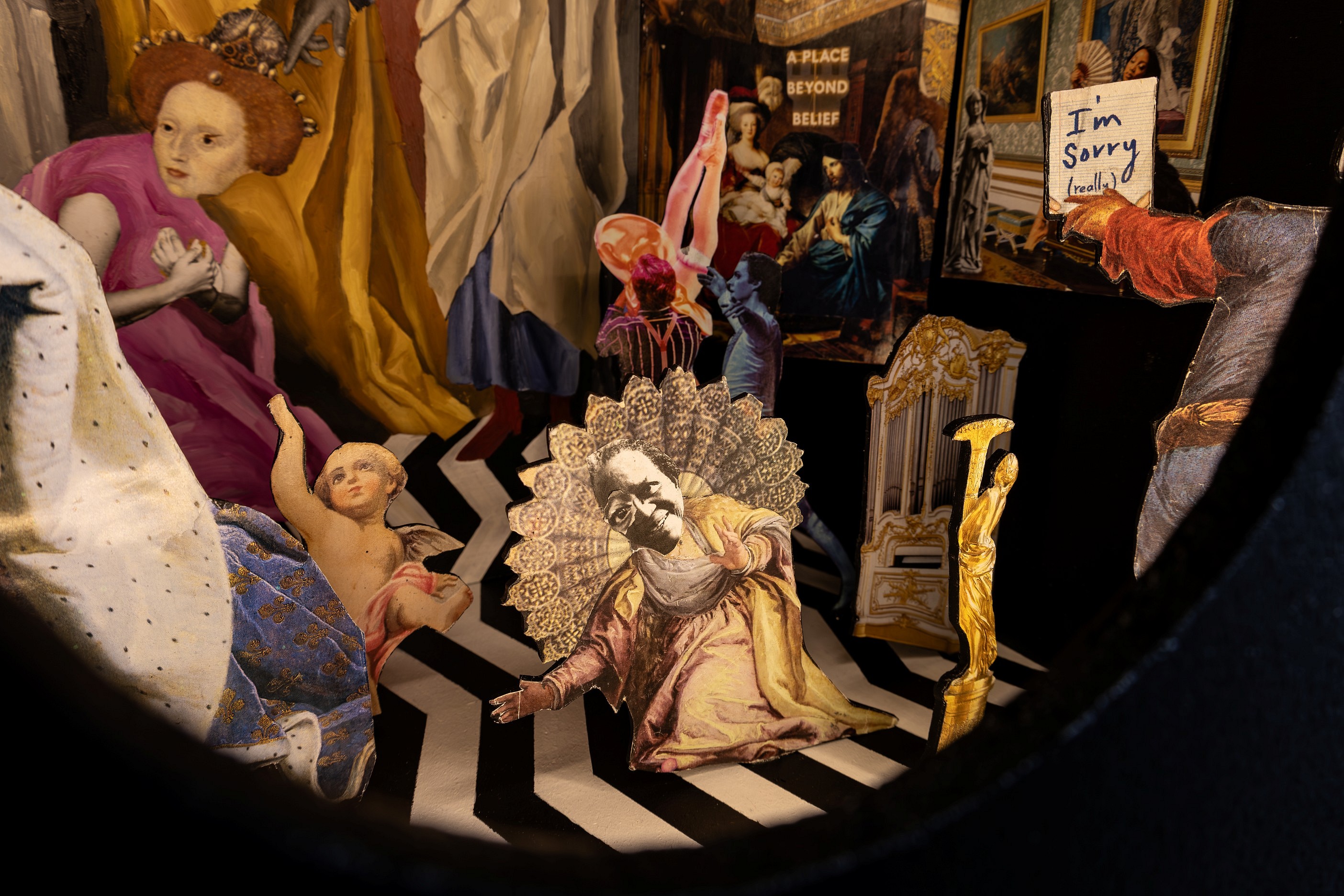
Keabetswe Seema creates bold depictions of female experiences, traced through futuristic and surrealist elements that highlight how she sees herself as a Black woman in the world. By merging painting and collage, while also experimenting with multiple dimensions, Seema’s practice is an exercise in world-building. Her dreamscapes for self-imaging merge illogical juxtapositions and play with form and texture. Another instance of experimentation with form is exhibited through Rebaone Finger's vessels sculpted from clay, where she continues her inquiry into the different markers of class. For Finger, food, identity, nomenclature and consumerism are all entangled as symbols that communicate desire and status. The classic chicken feet fingers that have come to signify her practice find themselves at the top of these vessels, a strange and tongue-in-cheek absurdity, that points to a kind of humour that she uses to dissect social hierarchy, economic stratification and privilege.
As the only artist in the show from Botswana, Katlego C.L Twala is concerned with the conventions of painting itself. Through a rigorous and classical painterly technique, she meditates on the quality and behaviour of light, while depicting those who are dear to her. Her sensibilities are gestural, contemplative and exacting, focused on painting as a language that she reaches toward with reverence for its long tradition while also asserting her own place within its long history.
'Does it end in a miracle?' brings together varied agencies in conversation. The tracks are at times parallel and at other times divergent. Whether the work is or is not subjected to the strictures of womanhood, what is undeniable is the manifestations of skill and agency. Encoded in these works are strategies of resistance, acts of reclamation and visions of futurity that still somehow remain fluid.
— Nkgopoleng Moloi
This February, Everard Read in Cape Town will bring together the work of six women artists: Mmakgabo Mapula Helen Sebidi, Mary Sibande, Teresa Kutala Firmino, Keabetswe Seema, Rebaone Finger and Katlego C.L. Twala, all of whom practise in different modalities across painting, collage and sculpture. Titled 'Does it end in a miracle?' and with works spanning over half a century, the sharply focused exhibition is an intergenerational dialogue that weaves together past and future, and alternative realities alongside historical recurrences. It is an exploration of how the artists see and represent themselves in the world. How they reflect on power, matriarchy, family, pleasure, fantasies and fears.
Writing in 'Speech Acts' (2024), critic and curator Geeta Kapur reflects on the importance of historical lineages in fully grasping the contemporary. She posits that a dehistoricised global contemporary that focuses on the here and now tends to generate uncritical slippages. A historical contemporary, conversely, while volatile, is always influenced by what came before. The key, then, is to 'fragment the modern and release fresh genealogies for the contemporary'. By tracing matrilineally transmitted knowledges from far-off lands or, more importantly, nodding to the stories of those who precede us, we can acknowledge the long, undulating trails of history. 'Does it end in a miracle?' enacts this kind of critical reflection while celebrating the work of important contemporary artists working today.
The history of women-only shows began, formally, as early as the 1850s, with societies of women artists across major cities in the West. Their emergence paralleled the acceptance of women into private art institutions. In the early 20th century, these shifts became muted when women sought equality in society, as if real strides in material justice revoked their right to symbolic representation. As women's studies proliferated across cultural and political fields, 'women's work' was once again negotiated, with a particular focus, in later years, on intersectionalities between class, race and sexual orientation. Even with this rich and cyclical history, the work is not done, as the need to address refusal and silencing continues to be a key question. Read in this light, shows celebrating women artists remain instrumental to carving out significant trajectories of rebellion, dignity and justice.
Whilst some work in this exhibition is rooted in questions related to gender experiences, others have found ways to explore the human condition outside the bounds of gender. The artists engage in varying subject matter through their subjectivity, some of which has nothing to do with womanhood. Their artistic practices, then, are emblems of the knowledge that they carry, shared through paint, ink, paper and clay.
Mmakgabo Sebidi, in particular, lays some of the groundwork. Her practice serves as a touchstone for understanding resilience, passion and innovation, all of which we witness in artists that follow her path. Spanning over five decades of creation, Sebidi’s work is instructive. From a technical perspective, she mastered painting and sculpture at a time and in a place where many like her were not allowed and did not have the opportunity to make art. Following her dreams, especially in the literal sense, Sebidi created a palimpsest upon which generations of contemporary artists can build their legacies. Her works in the exhibition vary in style and highlight her impressive oeuvre and decades-long evolution of her practice. Take, for instance, the earliest work, created circa 1979, which varies greatly from the almost pointillistic layered technique she became well-known for. This significant historical work is a serene depiction of a group of women gathered around a tree in a field, one carrying a baby, no doubt exchanging juicy stories about the day’s happenings. The work is in stark contrast to her later paintings, which are preoccupied with the connection between the spiritual and the physical worlds, rendered through an interesting kind of figuration. Often, we see figures that morph into each other, connected through limbs or multiple heads. Animals, too, play an important part in her depictions, particularly the fish, the animal that represents her clan, Batho Batlhaping. Weaving together dreams, ancestry, landscape and fantasy, Sebidi’s visual language is entirely her own. She is a great colourist and an even greater provocateur.
Linked to her is Mary Sibande, who uses the human figure as a focused critique of stereotypical depictions of Black women through her alter ego and protagonist, Sophie. Understanding the body as a site where history is contested and where an artist's fantasies can play out, Sibande reanimates Sophie’s life through an ever-expanding universe that revolves entirely around her fantasies. Sophie takes on new incarnations of herself, unbound from the history of servitude and labour, reflecting complex personhoods of Black women like Mary, her mother and her grandmother, whose lives the earlier work drew on and wished to make visible, and to celebrate. Sibande, then, connects her past and future through a thread woven with fables and fabulation.
Alongside her is Teresa Kutala Firmino, whose new body of work maps the contours of girlhood, thinking through how Black girls are often robbed of their girlhood much earlier and miss out on the adventures of play because of how they are read and treated in society. Drawing on the writings of Françoise Vergès and bell hooks, Firmino engages with Black girlhood and Black women's childhoods, piecing together new and old narratives. Rendered with faces made to evoke African masks and elements of geometry, the incredibly detailed works exude an eeriness that lingers through the half-human figures. In many ways, Sibande and Firmino are singing the same note, one that requires a recognition of rest, leisure and joy as fundamental rights that Black girls and women deserve.
Keabetswe Seema creates bold depictions of female experiences, traced through futuristic and surrealist elements that highlight how she sees herself as a Black woman in the world. By merging painting and collage, while also experimenting with multiple dimensions, Seema’s practice is an exercise in world-building. Her dreamscapes for self-imaging merge illogical juxtapositions and play with form and texture. Another instance of experimentation with form is exhibited through Rebaone Finger's vessels sculpted from clay, where she continues her inquiry into the different markers of class. For Finger, food, identity, nomenclature and consumerism are all entangled as symbols that communicate desire and status. The classic chicken feet fingers that have come to signify her practice find themselves at the top of these vessels, a strange and tongue-in-cheek absurdity, that points to a kind of humour that she uses to dissect social hierarchy, economic stratification and privilege.
As the only artist in the show from Botswana, Katlego C.L Twala is concerned with the conventions of painting itself. Through a rigorous and classical painterly technique, she meditates on the quality and behaviour of light, while depicting those who are dear to her. Her sensibilities are gestural, contemplative and exacting, focused on painting as a language that she reaches toward with reverence for its long tradition while also asserting her own place within its long history.
'Does it end in a miracle?' brings together varied agencies in conversation. The tracks are at times parallel and at other times divergent. Whether the work is or is not subjected to the strictures of womanhood, what is undeniable is the manifestations of skill and agency. Encoded in these works are strategies of resistance, acts of reclamation and visions of futurity that still somehow remain fluid.
— Nkgopoleng Moloi
EVERARD READ CAPE TOWN - 3 Portswood Road
Cape Town, 8002
South Africa
+27 21 418 4527 | ctgallery@everard.co.za
Operating hours:
Monday - Friday 9:00 - 17:00
Saturday - 9:00 - 13:00
If you are looking to add to your collection and you are unable to make it to our gallery during operating hours, please contact us via ctgallery@everard.co.za to make an appointment outside of these hours.